
How Long Does a Tankless Water Heater Last? What Colorado Homeowners Should Expect
A properly installed and maintained tankless water heater can often provide close to 20 years of service. That is longer than the approximately 10- to 15-year projected lifespan of many traditional tank-style water heaters in the Boulder-Denver area.
Actual results vary, however. Water quality, maintenance, installation, household hot water demand, and the availability of replacement parts can all affect how long a tankless system remains reliable. Understanding these factors can help you protect your investment and recognize when an older unit needs professional attention.
Why Can Tankless Water Heaters Last Longer?
 A conventional water heater stores heated water inside a steel tank. Over time, corrosion and mineral accumulation can weaken the tank and eventually cause it to leak. Once the tank itself fails, the entire water heater generally needs to be replaced.
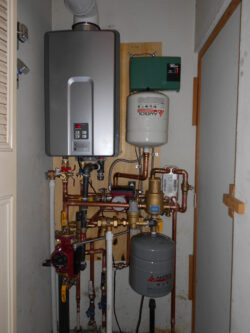
A tankless water heater works differently. It heats water as it flows through a heat exchanger, eliminating the large storage tank. Tankless systems also contain serviceable components such as valves, sensors, fans, and igniters that may be replaced individually.
These design differences can contribute to a longer service life, but tankless systems are not maintenance-free. The heat exchanger and other components still experience wear, and mineral buildup can interfere with performance if it is not addressed.
What Affects a Tankless Water Heater’s Lifespan?
Water Quality and Mineral Buildup
Water hardness refers to the amount of dissolved minerals, primarily calcium and magnesium, in the water supply. When water is heated, those minerals can form scale inside the heat exchanger and other internal passages.
Scale can interfere with heat transfer, making the unit work harder to produce hot water. Over time, excessive buildup may reduce efficiency, affect water temperature, and place additional stress on system components.
Water quality varies between Colorado communities and individual homes. Maintenance and water treatment recommendations should therefore be based on the conditions at the property. We explain the connection in Why You Should Pair Your Water Heater With a Water Softener.
Maintenance
Regular maintenance can help control mineral buildup and identify developing problems. Depending on the model, water quality, and system condition, tankless water heater service may include:
- Flushing or descaling the heat exchanger
- Cleaning the water inlet filter
- Inspecting the burner and combustion system
- Checking the air intake and venting
- Inspecting water, gas, and condensate connections
- Testing safety controls and reviewing error codes
Maintenance frequency should follow the manufacturer’s instructions and account for local water conditions. Homes with harder water or significant hot water demand may require more frequent attention.
Professional Installation and Proper Sizing
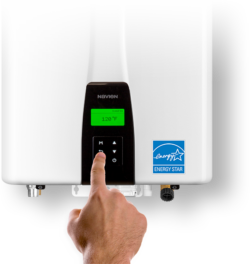 Installation quality can affect both performance and longevity. A whole-house gas-fired tankless water heater needs correctly sized gas piping, approved venting, adequate combustion air, proper drainage when applicable, and sufficient water flow.
The equipment must also be sized for the household’s hot water needs. A system that is too small may struggle when multiple showers, faucets, or appliances call for hot water at the same time.
Tankless sizing requires particular attention in the Denver-Boulder area. Gas-fired equipment may produce less heat at higher elevations because less oxygen is available for combustion. Colder incoming water also requires the system to produce a greater temperature rise before the water reaches the desired delivery temperature.
These local conditions may not be fully reflected in general online sizing charts. Our guide to sizing a whole-home tankless water heater in Denver-Boulder explains why a professional local assessment matters.
Household Hot Water Use
A tankless water heater activates whenever sufficient hot water flow is detected. A household with several occupants, frequent laundry, multiple daily showers, or simultaneous hot water use will place more demand on the equipment than a smaller household.
Tankless systems are designed for regular use, but operating hours and cycling still contribute to wear. Correct sizing and consistent maintenance become especially important in homes with greater hot water demand.
How Can You Help a Tankless Water Heater Last Longer?
Homeowners can support reliable operation by taking a few practical steps:
- Follow the manufacturer’s maintenance recommendations.
- Have recurring error codes evaluated instead of repeatedly resetting the unit.
- Address leaks, unusual noises, and temperature fluctuations promptly.
- Keep the air intake and exhaust termination clear.
- Consider water treatment if testing identifies problematic hardness or scale.
- Leave internal gas, electrical, venting, and control adjustments to a qualified professional.
Water treatment should be matched to the conditions in the home rather than treated as a one-size-fits-all solution. Learn more in What Is Hard Water?.
Signs an Older Tankless Water Heater Needs Attention
A tankless water heater may show signs of deterioration before it stops working completely. Watch for:
- Fluctuating water temperatures
- Reduced hot water flow
- Difficulty meeting normal household demand
- Recurring error codes
- Unusual operating noises
- Leaks from the unit or its connections
- Frequent ignition or shutdown problems
- Increasingly frequent or expensive repairs
These symptoms do not automatically mean the unit needs to be replaced. Mineral buildup, a clogged filter, a worn sensor, or another repairable issue may be responsible. A professional evaluation can identify the cause and determine whether repair remains practical.
When Should You Repair or Replace a Tankless Water Heater?
Age alone should not determine the decision. Repair may make sense when the system has otherwise been reliable, the heat exchanger remains in good condition, and replacement parts are readily available.
Replacement may be more practical when:
- The heat exchanger is leaking or severely scaled
- The system requires increasingly frequent repairs
- Major replacement parts are unavailable
- The unit no longer meets the household’s hot water needs
- Installation or sizing problems limit performance
- The repair cost is high relative to the system’s age and condition
There is no universal age at which every tankless unit must be replaced. Learn more about choosing between water heater repair and replacement.
Tankless Water Heater Service in the Boulder-Denver Area
 A well-selected and properly maintained tankless water heater can often provide close to 20 years of service. Water quality, maintenance, household demand, sizing, and installation all influence whether the unit reaches that projected lifespan.
Save Home Heat Company provides whole-house gas-fired tankless water heater installation, maintenance, and repair throughout the Boulder-Denver metro area. Our team understands how elevation, incoming water temperature, household demand, and local water conditions affect tankless performance.
Learn more about our tankless water heater services or contact Save Home Heat Company for professional assistance.